
 English
 日本語
日本語 中文简体
中文简体
Content
Two mills can both quote a 220 gsm cotton interlock knit fabric and still hand you materials that behave like two different products. One washes down to 214 gsm, loses around 3% of its width and stays square on the grain. The other comes back at 200 gsm, twists noticeably off grain and shows faint needle lines under retail lighting. The fabric name is identical. The specification sheet is not.
That is the short version of the argument in this article: cotton interlock is a construction family, not a single product, and how it performs is decided by yarn count, machine gauge, loop length, dyeing route and finishing long before it reaches a cutting table. Write "cotton interlock, 220 gsm" on a purchase order and you have handed your quality standard to whoever sets the machine that day.
What Cotton Interlock Knit Fabric Actually Is
Interlock is a double knit. Two sets of needles, usually on a circular machine with a cylinder and dial arrangement, knit two yarns at the same time, and the loops from each set interlock rather than sitting back to back. Both faces end up looking like the right side of a single jersey: fine vertical wales, an even surface, no visible purl.
Four consequences matter at the buying stage:
- It is genuinely reversible. There is no face and back to track through cutting, which simplifies panel layout and reduces the risk of a reversed piece slipping into a bundle.
- Cut edges do not curl. Single jersey rolls at the edge and needs extra allowance; interlock lies flat, so open-width conversion and narrow trims behave predictably.
- It has more body per unit weight. Two yarns per course make a 200 gsm interlock read as denser and more opaque than a 200 gsm single jersey, which is exactly why it is chosen for white and light-coloured T-shirts.
- It stretches less. Widthwise elongation sits well below single jersey at a comparable weight, so garments hold their shape but feel less forgiving in close-fitting styles that depend on jersey stretch.
Interlock also needs separating from rib, because the two get confused in spec sheets. A 1x1 rib uses two needle beds as well, but its wales alternate between face and back, producing vertical cords and far higher crosswise stretch. Interlock is flat and uniform on both sides. Order the wrong one and the hand feel, recovery and drape are all wrong before a single garment is sewn.
Shirting programmes show the range clearly. A drop-needle pure cotton interlock, for instance, is built to keep a clean surface and a crisp hand while staying soft against the skin:
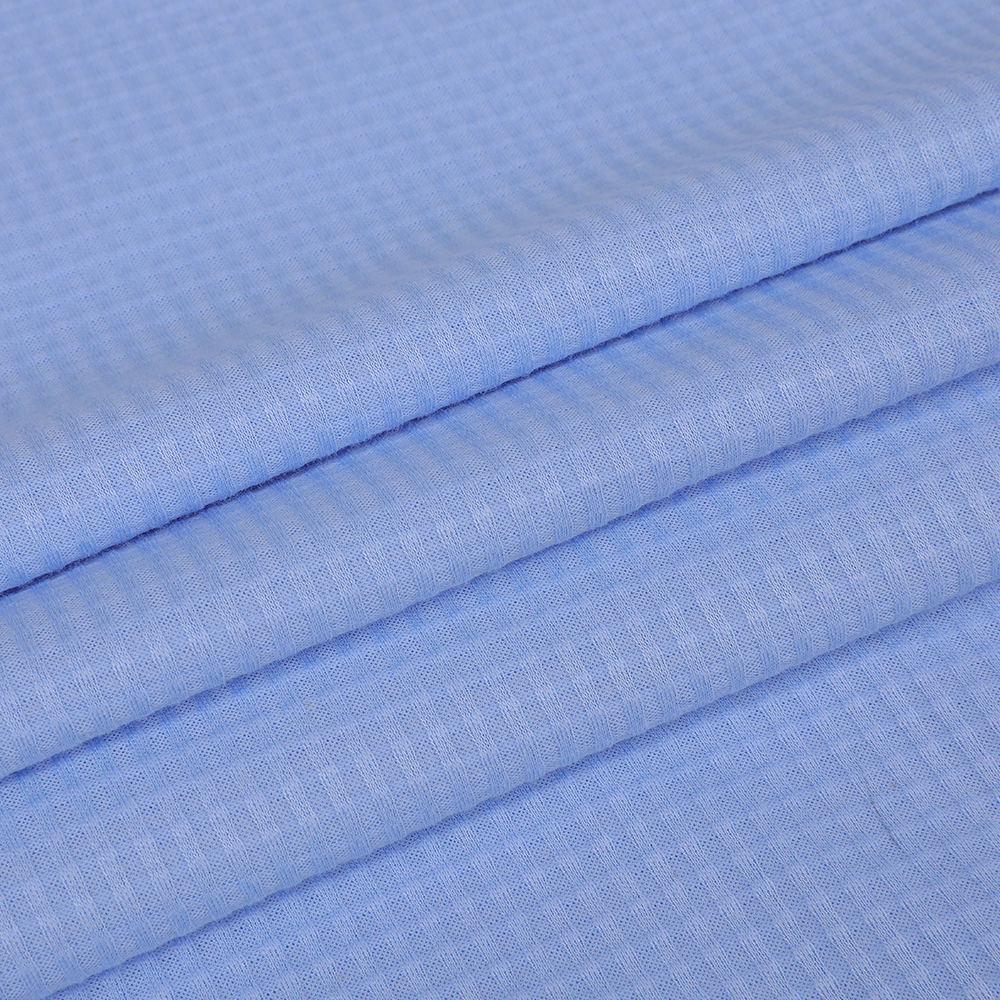 Soft Skin-Friendly Drop Needle Cotton Interlock Shirting FabricA pure cotton shirting interlock with needle-drawn texture, soft hand and 165 GSM, useful when specifying softness, breathability and laundering limits.View Product →
The Numbers That Belong on the Specification Sheet
A cotton interlock order without tolerances is an argument waiting to happen. These are the parameters worth writing down, together with the ranges most commercial programmes work inside.
| Parameter | Typical commercial expectation | How to verify it |
|---|---|---|
| Finished weight | 140-320 gsm depending on end use; plus or minus 5% is a common tolerance | Cut-test three swatches after one home wash, never on greige |
| Machine gauge and yarn count | 20-28 gauge on circular interlock machines, matched to Ne 30s or 40s combed cotton | Ask for gauge and yarn count in writing, not just weight |
| Finished width | 160-190 cm tubular or open width after relaxation | Measure after wash; serious compacting always costs width |
| Widthwise stretch | Clearly lower than single jersey at the same weight | Test at a defined load so results stay comparable between labs |
| Residual shrinkage | Around 5% or less in both directions after one wash | ISO 6330 or AATCC 135, three cycles |
| Spirality | Under 5%, with premium programmes capping it lower | Square a washed panel and measure the twist off grain |
| Pilling resistance | Grade 3-4 or better | Martindale or ASTM D4970 |
| Colourfastness | Grade 4 or better to washing and rubbing on reactive-dyed cotton | ISO 105 or the equivalent AATCC method |
| pH value | 4.0-7.5 for skin-contact garments | Testing on the finished, washed fabric |
Two notes on the table. Weight and width move together: a mill that stretches the fabric to hit a width target will finish under weight, and a mill that finishes heavy will lose width. And greige figures mean nothing to a garment maker. Every number should be measured after washing, on the same sample, by the same method.
Matching Weight and Gauge to the End Use
Weight alone does not describe an interlock. The same 200 gsm can be knitted from Ne 30s combed cotton on a fine gauge machine for a smooth, soft, slightly fluid hand, or from a coarser yarn on a heavier gauge for more body, more texture and less drape. Gauge and yarn count belong in the spec next to the weight.
- 140-170 gsm: lightweight innerwear, camisoles, babywear, summer layering pieces and print bases where opacity is not critical.
- 170-210 gsm: the volume zone, covering plain and printed T-shirts, long-sleeve tops, uniforms and promotional programmes.
- 210-260 gsm: dresses, structured tops, lightweight sweatshirts, maternity wear and softer joggers.
- 260-320 gsm: heavier tops, loungewear and winter layering that must hold a silhouette without a lining.
If the programme is T-shirt led, weight, yarn count and test requirements deserve their own working document. Our breakdown of 100% cotton T-shirt fabric specifications and sourcing covers those decisions in more detail, from yarn selection through to final inspection.
Where the goal is a soft, stable T-shirt body rather than the cheapest possible tube, liquid ammonia finishing on a cotton interlock is often the route chosen:
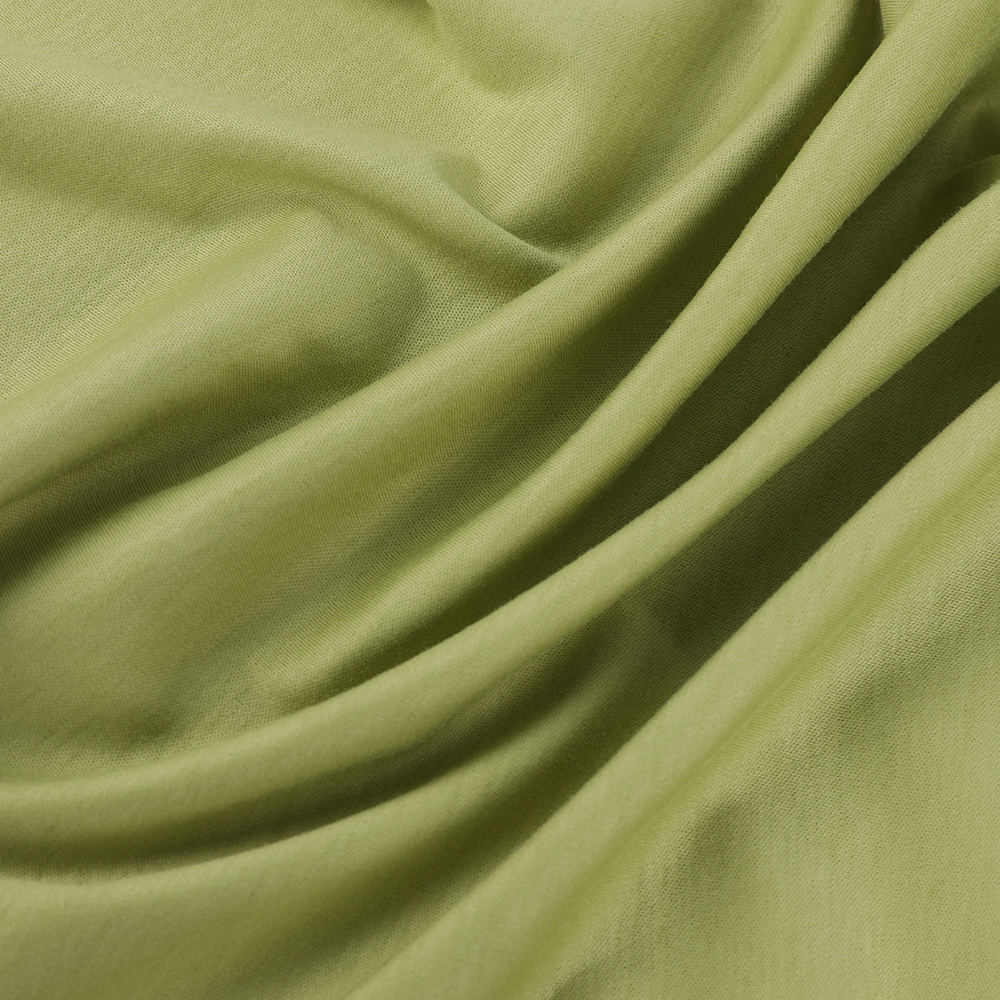 Breathable Liquid Ammonia Cotton Interlock T-Shirt FabricA soft, stable cotton interlock T-shirt fabric with liquid ammonia finishing, offering smooth hand feel, breathability and 155 GSM versatility.View Product →
To see how these constructions sit within a wider offer, you can browse our knitted fabric programme by end use rather than by fibre.
Finishing Choices That Decide How the Fabric Feels
Cotton interlock leaves the knitting machine as a workable but unremarkable fabric. What a buyer receives is largely the product of finishing, and each step trades one property against another.
- Liquid ammonia treatment: swells the fibre and re-organises the cellulose structure, giving a smoother, softer hand plus better dimensional stability and wrinkle resistance than caustic mercerisation alone. It is the single biggest reason two cottons of the same weight can feel like different fibres.
- Mercerisation: adds lustre, strength and dye uptake, so dyed shades look deeper and more even and the surface resists abrasion better.
- Enzyme or bio-polishing: removes surface fuzz and reduces pilling, but over-processing thins the fabric and costs strength. Ask for the treatment level, not just the treatment name.
- Compacting: trades width for controlled residual shrinkage. Expect a narrower finished width if the mill is serious about stability.
- Softeners: silicone gives an immediate, luxurious hand but can reduce absorbency and complicate print adhesion, while hydrophilic softeners feel less slick but behave better in downstream finishing.
The trade-off is real and belongs in the spec: the softest hand is usually the weakest on pilling, and the most stable fabric is usually the narrowest. Decide which one the garment actually needs.
Adding a small amount of elastane shifts the calculation again. For women's wear, a cotton spandex interlock is a common answer when both recovery and a soft hand matter:
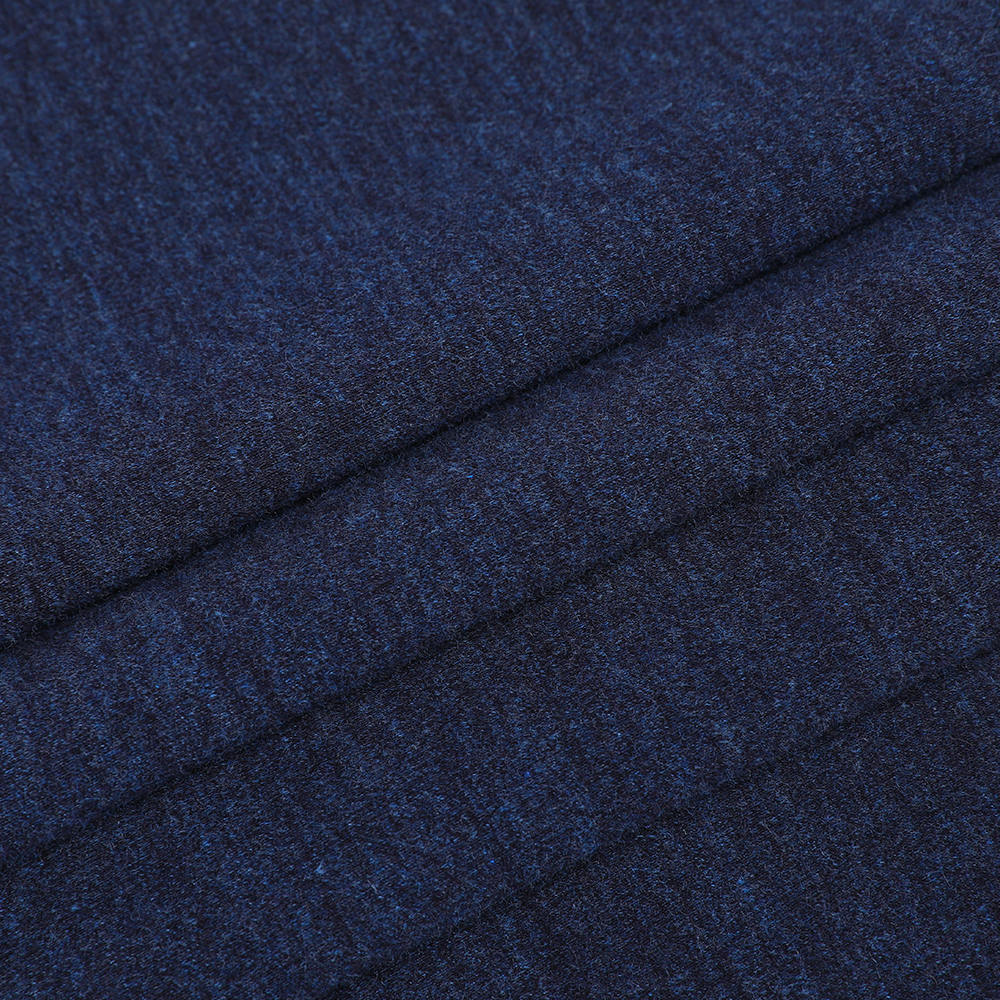 Eco-Friendly Cotton Spandex Interlock Fabric for WomenA women's cotton-spandex interlock balancing soft hand and recovery, with eco-friendly processing and 95/5, 230 GSM construction.View Product →
Where Cotton Interlock Orders Usually Go Wrong
- Spirality. The fabric twists off grain after washing and side seams swing forward, caused by yarn twist, loop distortion or insufficient relaxation before slitting. Cap it in the spec and test it on a squared panel, not a rectangular strip.
- Needle lines. Vertical streaks from a bent needle, a worn sinker or uneven yarn tension. Nearly invisible in greige and obvious under retail lighting, so inspect after dyeing and finishing.
- Barré and shade banding. Usually a yarn lot problem rather than a dyeing problem, which is why mixing yarn lots within one order is a risk worth refusing.
- Weight measured in greige. A fabric sold as 220 gsm can finish at 205 gsm after washing and compacting, and the garment that was costed at 220 gsm quietly gets thinner.
- Shade variation between dye lots. Reactive-dyed cotton tolerates a small tolerance window at best. Keep a sealed standard and check each lot against it under the same light source.
A Working Sourcing Sequence
- Write the specification with tolerances: weight, gauge, yarn count, width, stretch, shrinkage, spirality, pilling and pH.
- Request a lab dip together with a hand sample of the exact construction, not a substitute from stock.
- Run 5-10 metres of trial yardage and wash it three times, re-measuring weight, width and spirality each cycle.
- Approve against a sealed standard and confirm which test methods will settle any dispute.
- Require per-lot reports on shade, weight, width, shrinkage and pilling before shipment is released.
- Check the care label wording against the fabric that was actually tested, not against the fabric that was intended.
A supplier who can talk about loop length, compaction loss and spirality limits in the same conversation is usually a safer partner than one who only quotes a price per kilogram.
Cotton interlock knit fabric rewards buyers who treat it as an engineered product rather than a catalogue line. Get the weight, gauge, stretch and shrinkage targets onto paper, test them on washed samples, and the fabric that arrives will match the garment you costed. Skip that step and the difference shows up at the fitting, not on the invoice.