
 English
 日本語
 中文简体

Content
- 1 What cotton jersey knit fabric actually is
- 2 Six numbers that decide whether a sample is approvable
- 3 Single jersey, interlock and French terry are not interchangeable
- 4 The finishing route, not the fibre, sets the shrinkage band
- 5 Where cotton jersey works, and where it fails
- 6 A six-step sourcing sequence that avoids a second sample round
Two swatch cards land on the same desk in the same week. Both read 100% cotton jersey. One is 145 gsm, the other 215 gsm, and only one of them will still fit the fit model after three home washes. The fibre is identical; the difference sits in stitch length, yarn count, and whatever happens between dyeing and the final compaction pass. This guide is written for the person who has to sign off that swatch: what the structure is, which numbers belong in the purchase order, and how a mill's finishing route changes the answer.
What cotton jersey knit fabric actually is
Cotton jersey knit fabric is a single-face weft knit built on one needle bed, where every loop is drawn through a loop from the same yarn set. That construction produces a smooth technical face, a purl back, and width stretch of 30% to 50% before finishing, with far less stretch along the length.
Definition: cotton jersey knit fabric is a weft-knitted single-face structure in which all loops are formed on the same needle bed, giving one smooth face, one purl face, and two-way stretch that recovers mainly across the width.
With only one needle bed, nothing balances the loop curl on the back of the cloth. Cut a light single jersey and the edge rolls toward the face within minutes. That behaviour is structural rather than a mill defect, which is why jersey panels are cut with a slightly wider seam allowance and why necklines are stabilised with tape before sewing.
Construction moves hand-feel more than fibre does. A 180 gsm cotton single jersey knitted at E28 gauge from Ne 30 combed ring-spun yarn, at a stitch length near 2.7 mm, reads dense and dry in the hand. Hold the same 180 gsm and move to Ne 40 yarn with a longer stitch, and the cloth becomes smoother against the skin while losing some seam strength. Open-end yarn lowers yarn cost per kilo and knits faster, at the price of earlier pilling on the face.
Six numbers that decide whether a sample is approvable
Six parameters decide whether a cotton jersey sample is approvable: weight within +/-4%, open width within 2 cm, residual shrinkage at 3% or less after three wash cycles, spirality at 5% or less, pilling at grade 4 or better, and colourfastness to washing at grade 4 or better. Put them into the purchase order before sampling and the first bulk lot usually passes.
A tolerance table agreed in writing costs less than a re-order. The band below is the one normally set for a 180 gsm cotton single jersey used in t-shirts and loungewear, and the test methods are the ones a mill and a buyer can both run and compare on the same bench.
| Parameter | Target | Why it decides the order | Test method |
| Fibre composition | 100% cotton, +/-2% | A 5% elastane addition changes drape and heat-set behaviour | ISO 1833 |
| Weight | 180 gsm, +/-4% | Under 150 gsm reads sheer in white; above 200 gsm the jersey drape disappears | ISO 3801 |
| Open width | 175 cm, +/-2 cm | Marker efficiency; 2 cm of width is roughly 1% of fabric cost per garment | ISO 3932 |
| Residual shrinkage | 3% length, 3% width maximum | Fit drift between size set and bulk delivery | AATCC 135 |
| Spirality | 5% maximum | Side seams twist toward the front after washing | AATCC 179 |
| Pilling | Grade 4 minimum | Surface fuzz drives retail returns on dark shades | ISO 12945-2 |
| Colourfastness to washing | Grade 4 minimum | Bleed onto rib trims and contrast panels | ISO 105-C06 |
Single jersey, interlock and French terry are not interchangeable
Single jersey uses one needle bed and is normally sold between 120 and 220 gsm; interlock uses two needle beds and sits between 180 and 300 gsm; French terry adds tuck loops on the back and starts near 240 gsm. Swapping one for another changes fabric weight by 25% to 60% and changes how a cut panel recovers.
- One needle bed, purl back, 120 to 220 gsm
- Width stretch 30% to 50%, lower recovery
- Edges curl hard and need stabilising at seams
- Suited to light t-shirts, singlets and underwear
- Two needle beds, two smooth faces, 180 to 300 gsm
- Width stretch 20% to 35%, better recovery
- Edges curl little, so cutting yield is cleaner
- Suited to heavier t-shirts, dresses and structured tops
The fastest field test on a swatch table is the curl test: cut a 5 cm square, leave it ten minutes, and watch the corners. Single jersey rolls hard; interlock barely moves. The second test is weight, because at the same yarn count interlock is roughly 1.7 to 2 times heavier per square metre than single jersey.
A t-shirt programme that needs a smooth face on both sides and a liquid ammonia finish usually ends on interlock:
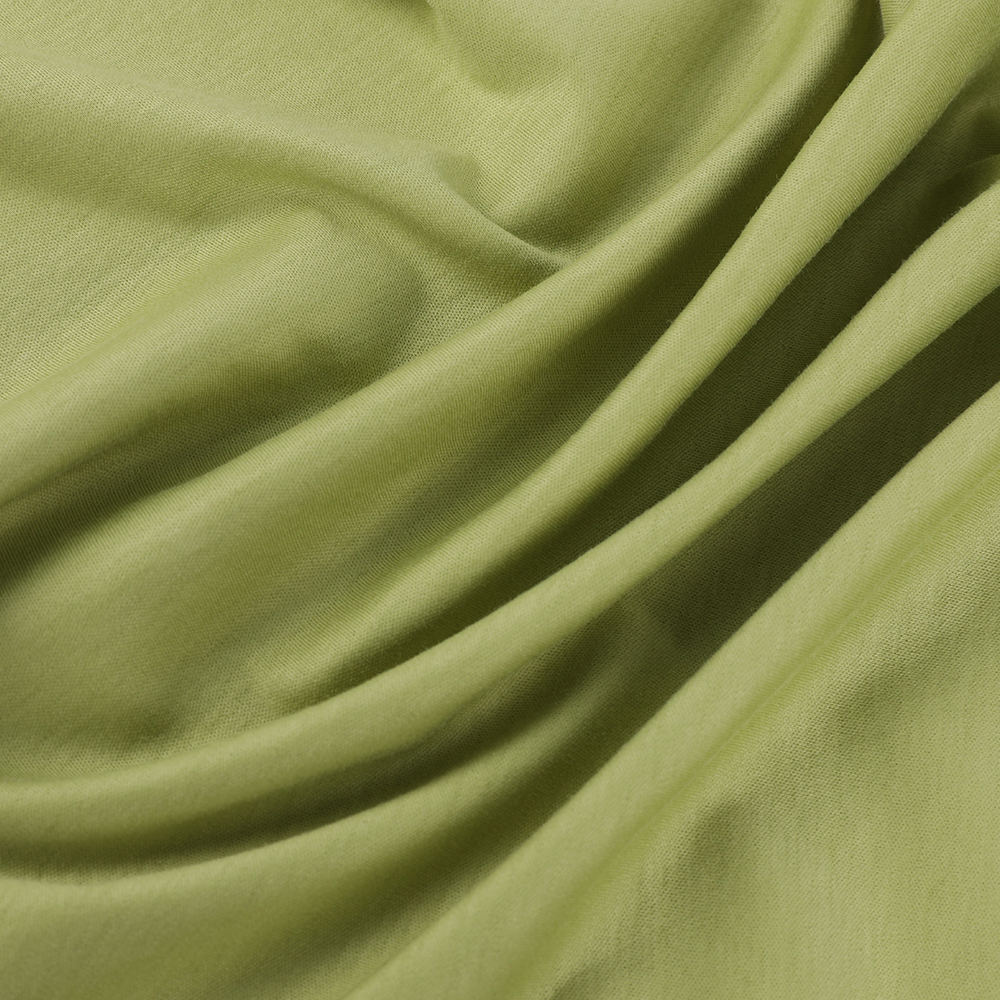 Interlock LA Comfortable Breathable Cotton Liquid Ammonia T-shirt FabricSerial number: 47718/S200483View Product →
The finishing route, not the fibre, sets the shrinkage band
Residual shrinkage on the same 180 gsm cotton single jersey falls from about 6.5% to about 1.9% after three AATCC 135 wash cycles, and the only variable is the finishing route: stentered without compaction, dyed with standard compaction, enzyme washed and compacted, or liquid ammonia finished and compacted.
Liquid ammonia finishing runs at minus 33 C with very low viscosity, so the ammonia reaches the core of the cotton yarn in seconds and swells the fibre through its whole cross-section rather than mainly at the surface. That swelling releases the internal stress left behind by spinning and knitting, which is exactly the stress that later appears as torque, spirality and length loss in a customer's washing machine. The same swelling produces the low-friction surface and the dry, soft hand that buyers notice on the swatch.
Where shrinkage performance is printed on the hangtag, a stable 2% matters more than a small yarn price gap. A jersey that arrives at 2% and stays at 2% protects the size set; a jersey that starts at 6% loses a whole grade after the first domestic wash.
A cotton jersey built on the liquid ammonia route, finished for t-shirt weight:
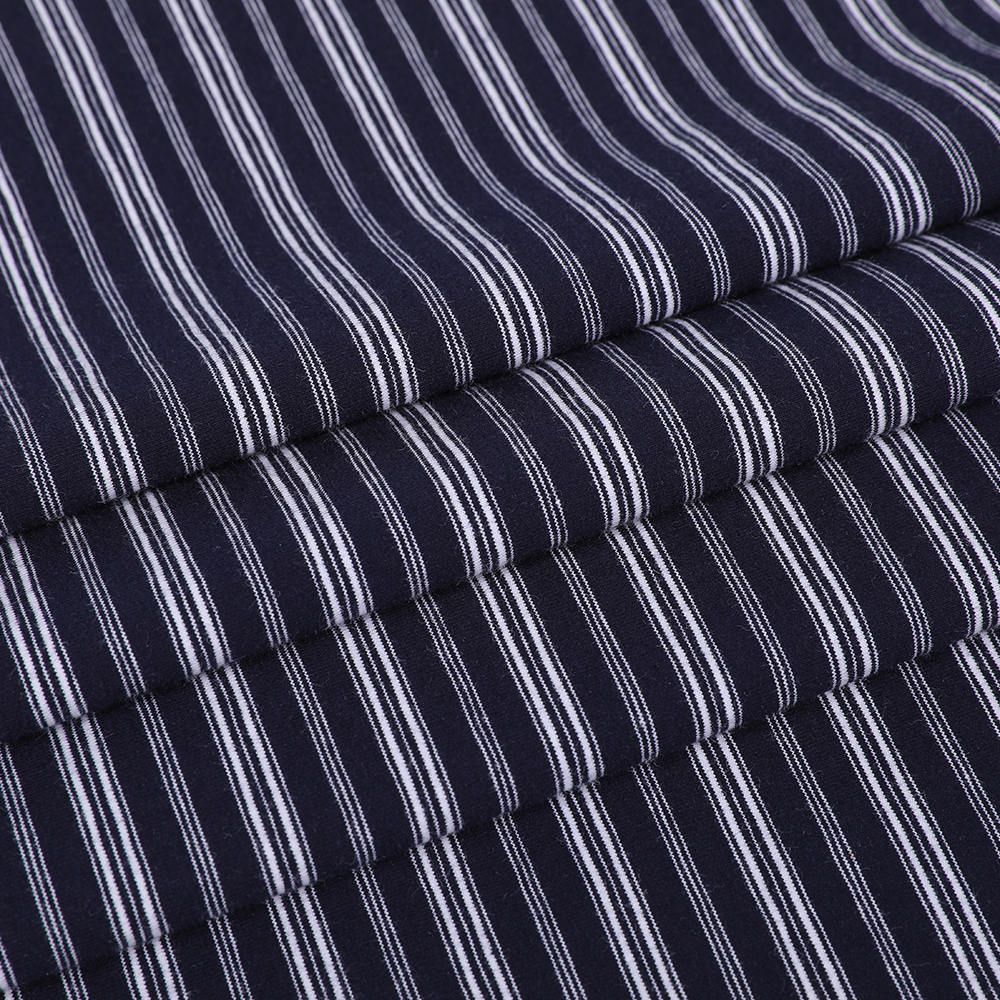 Breathable Jersey Cotton LA Liquid Ammonia Sweat Skin-Friendly T-shirt FabricSerial number: 53270/D222482View Product →
Where cotton jersey works, and where it fails
Cotton jersey is the right choice between 140 and 190 gsm for t-shirts, underwear, loungewear and kidswear; it is the wrong choice above 220 gsm for structured outerwear, and a risky choice for high-abrasion workwear unless yarn twist and knit density are re-engineered.
- T-shirt and polo bodies: 140 to 190 gsm, Ne 30 to Ne 40 combed cotton, pilling grade 4 minimum.
- Underwear and loungewear: 120 to 160 gsm, softer twist, sometimes with a small elastane addition for recovery.
- Kidswear: 140 to 180 gsm, with Oeko-Tex Standard 100 certification requested at the yarn stage.
- Dresses and heavier tops: 180 to 220 gsm, often knitted as interlock rather than single jersey for opacity.
Below 120 gsm, a white cotton jersey reads translucent under studio lighting and shows every seam allowance through the shell. Above 220 gsm, single jersey stops behaving like jersey: it loses the drape that made it attractive and starts to look like a heavy interlock without the recovery. For abrasion, ISO 12947-2 Martindale testing at 30,000 rubs separates a jersey that survives a workwear programme from one that pills out at 15,000.
For t-shirt programmes, weight and yarn count also set seam performance, and the yarn-count matrix in this guide to 100% cotton t-shirt fabric specifications is worth reading before the counter sample is approved.
An organic cotton jersey developed for women's t-shirt production, with the same weight band and a lower pilling risk:
 Breathable Eco-friendly Organic Knitted Cotton T-shirts Fabric for WomenThe fabric of the women's breathable and environmentally friendly organic knitted cotton wool T-shirt is made of selected organic cotton. The material comes from organ...View Product →
A six-step sourcing sequence that avoids a second sample round
Six checks, run in this order before a counter sample is approved, remove most of the back-and-forth on repeat cotton jersey programmes and typically shorten sampling from three rounds to one.
- Fix the end use and the weight band first: 160 to 190 gsm covers most t-shirts, 120 to 160 gsm covers next-to-skin styles.
- Set yarn count and gauge together. E28 with Ne 30 is the workhorse; E32 with Ne 40 gives a finer, lighter surface at the same weight.
- Name the test method, not only the number: AATCC 135 for the US market, ISO 6330 with ISO 5077 for Europe.
- Ask for a sample knitted from production yarn on a production machine, not a lab sample from a sample beam.
- Test spirality and pilling on the washed sample, never on greige.
- Write the tolerance table into the purchase order and attach the approved swatch as the reference standard.
Buyers who also run woven shirting alongside knit programmes can compare the knit route against the mill's pure cotton shirt fabric range before deciding which construction a season actually needs.
What GSM is cotton jersey knit fabric usually sold at?
Cotton jersey is sold between 120 and 220 gsm. T-shirt programmes sit at 160 to 190 gsm, with 180 gsm the single most common weight; underwear and loungewear run 120 to 160 gsm; heavier 200 to 220 gsm single jersey covers dresses and tops where opacity matters. Above 220 gsm, a single-face knit is normally replaced by interlock or French terry.
How much does cotton jersey shrink after washing?
Untreated cotton single jersey can lose 5% to 8% of length in the first three home washes. Compaction during finishing holds it to 3% or less, and a liquid ammonia route with compaction holds 180 gsm single jersey near 2%. Measure it with AATCC 135 at three cycles with tumble dry low, or with ISO 6330 and ISO 5077, and state the method on the purchase order.
How can you tell single jersey from interlock on a swatch?
Cut a 5 cm square and watch the edges. Single jersey curls toward the face within ten minutes; interlock stays nearly flat because two needle beds balance the loop tension. Weight confirms it, since at the same yarn count interlock is 1.7 to 2 times heavier per square metre and shows identical faces on both sides.