
 English
 日本語
 中文简体

Content
- 1 Match the Knit Structure to the T-Shirt You Are Making
- 2 Weight and Yarn Count Decide How a Tee Feels and Sells
- 3 Fiber Choice: Cotton, Blends, and Where Each Fits
- 4 Finishing: Where Shrinkage and Handfeel Are Won
- 5 Printing and Decoration: The Fabric Has to Cooperate
- 6 A Practical Checklist Before Bulk Production
A tech pack lands on the desk for a 180 GSM crew-neck tee. The first sample reads 171 GSM on the scale, and after three home washes the body has shortened by 6%. Nothing in the design changed — the fabric did. Loop length, yarn count and the finishing route decide whether a tee keeps its measurements or quietly loses them.
The short answer: settle the knit structure first, then the weight in GSM with an agreed tolerance, then the fiber blend and the finishing route. In T-shirt production those four decisions control drape, shrinkage, print quality and price per meter far more than the label on the yarn cone does. What follows explains how each one behaves on a real cutting table.
Match the Knit Structure to the T-Shirt You Are Making
Knit fabric is built from interlocking loops rather than interlaced yarns, which is why a tee stretches over the shoulders while a woven shirt does not. But "knit" covers several constructions that behave very differently once they are spread and cut.
Single jersey: the default tee body
Single jersey uses one set of loops on one needle bed. The face is smooth, the back shows purl loops, and the fabric is the lightest and most draping option — the construction most people picture when they say knit fabric for T-shirts. The trade-offs are edge curl on cut panels and spirality: the loop columns lean slightly, so a tubular body can twist after washing. A 4% to 5% skew tolerance is common in bulk contracts, and a ribbed neckline covers the curl at the collar.
Interlock: two smooth faces, less movement
Interlock knits two rib structures back to back, so both sides look identical. It is denser and more stable, curls far less, and takes a liquid ammonia finish well. The lower stretch means a tighter fit block is needed, and weight usually lands between 190 and 260 GSM.
Pique mesh: texture and airflow
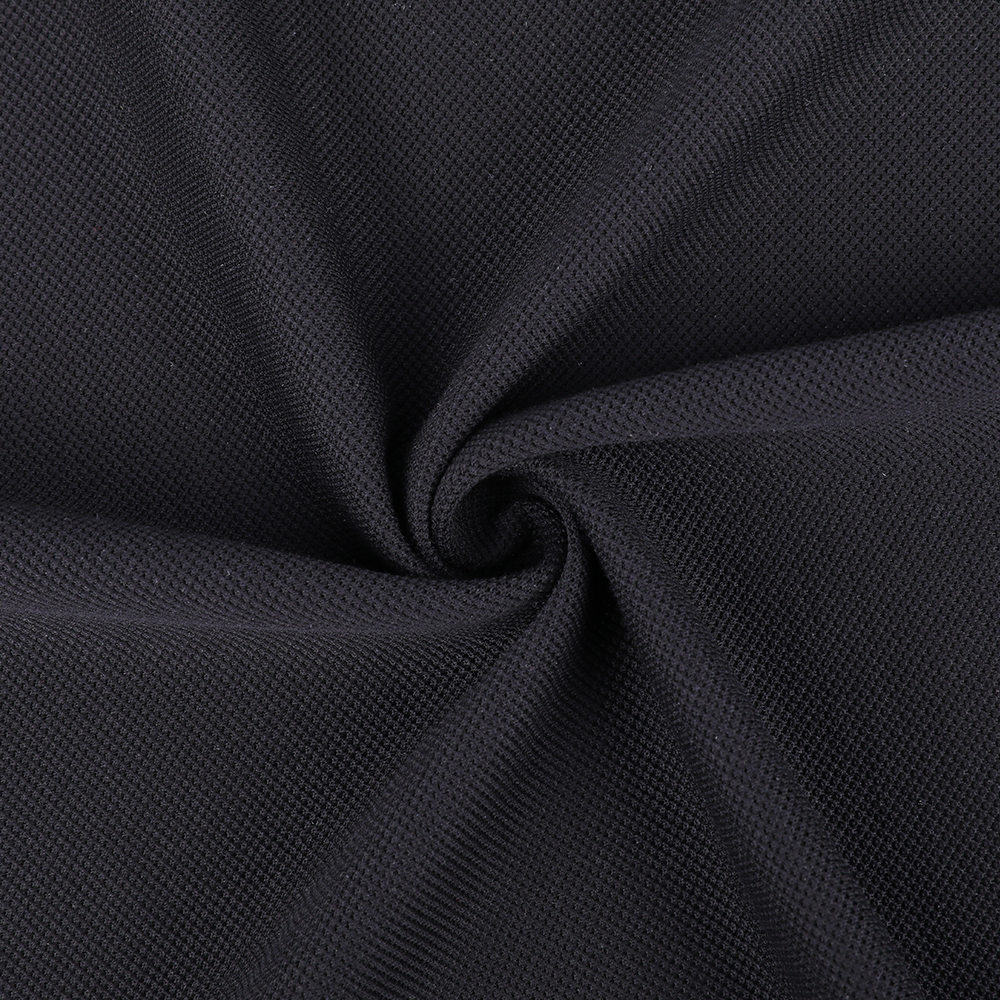
Pique builds a raised cell surface that lifts the fabric away from the skin. It is standard for polo shirts and increasingly used for breathable summer tees in hot, humid markets, with slightly less drape and a more structured silhouette.
Rib and terry: supporting roles
1x1 and 2x2 rib belong on neckbands, cuffs and side panels, not on the body. French terry and fleece are sweat fabrics; using them in a tee changes the garment category and the cost per piece.
| Structure | Typical weight | Stretch and recovery | Cut-edge behavior | Best suited to |
|---|---|---|---|---|
| Single jersey | 130-180 GSM | 15-25% width stretch, moderate recovery | Curls strongly, needs rib trim | Basic and printed tees, light summer tees |
| Interlock | 190-260 GSM | 10-15% stretch, good recovery | Minimal curl, stable | Heavyweight and boxy tees, liquid ammonia tees |
| Pique mesh | 170-220 GSM | 10-20% stretch, holds shape | Low curl | Breathable tees, polo shirts |
| 1x1 rib | 180-260 GSM | 30-40% width stretch | Minimal curl | Neckbands, cuffs, trims |
| French terry | 240-320 GSM | 10-20% stretch | Slight curl | Sweatshirts, not tee bodies |
Weight and Yarn Count Decide How a Tee Feels and Sells
Buyers usually specify GSM, but GSM alone is not a specification. Loop length, yarn count and needle gauge all change how a fabric of the same weight behaves:
- 130-150 GSM: light summer tees; watch for sheerness under stretch, especially in white.
- 160-180 GSM: the mainstream retail weight, balancing opacity, drape and cost.
- 190-220 GSM: heavyweight tees that hold a structured shoulder and accept embroidery well.
- 230-260 GSM: boxy streetwear tees; heavier needles, slower knitting, higher price per meter.
Yarn count runs alongside weight. A 40s combed cotton at 160 GSM gives a fine, smooth surface for detailed prints. A 30s yarn at 180 GSM adds body and better opacity in dark shades. A 26s yarn at 200 GSM produces a thick handfeel but can pill faster if fiber quality slips. Ask for both count and loop length in the tech spec, and set GSM tolerance at plus or minus 5% — a mill knitting to one target number will drift with humidity and machine tension.
Fiber Choice: Cotton, Blends, and Where Each Fits
Combed cotton remains the reference point for tees: breathable, printable and predictable. Long-staple cottons such as Supima knit into a smoother, stronger surface with less pilling after repeated washing, while organic cotton changes sourcing documentation more than it changes the handfeel.
 Breathable Organic Knitted Cotton T-Shirt Fabric for WomenA wholesale women's T-shirt fabric using organic cotton, aimed at breathable, temperature-regulating daily wear in spring, autumn, and cool early summer.View Product →
Blends solve specific problems. Adding around 5% spandex keeps a fitted tee from stretching out at the neck and elbows. Cotton with modal at roughly 60/40 increases drape and softness for premium basics. Cotton and polyester at 65/35 improves dimensional stability and color retention for uniforms and workwear, at the cost of some breathability. Silk and cotton blends push a tee into a higher price tier with a subtle sheen and a cooler, lighter handfeel.
Finishing: Where Shrinkage and Handfeel Are Won
Two fabrics can leave the knitting machine identical and arrive at the sewing floor as different products. Liquid ammonia treatment relaxes the cotton fiber, reducing residual shrinkage and producing a softer, less abrasive surface that keeps its shape after washing. Mercerized cotton adds luster and strength. Compacting and pre-shrinking control the residual shrinkage that would otherwise appear in the consumer's first wash, and bio-polish removes surface fuzz, improving print clarity while trimming a little weight.
 Breathable Eco-Friendly Liquid Ammonia Cotton Jersey T-Shirt FabricWholesale cotton jersey finished with liquid ammonia for a softer handfeel, moisture management, and comfort in T-shirts and sweat T-shirts.View Product →
Ask for shrinkage data from a three-wash test rather than a single laboratory wash. A limit of 5% in length and width after three cycles at 40 degrees is a realistic contract figure for well-finished cotton jersey; un-compacted tubular fabric can exceed 8% and will not hold the fit the pattern was cut for.
Printing and Decoration: The Fabric Has to Cooperate
Screen printing, digital printing and embroidery each place demands on the surface. Plastisol inks need a flat, tightly knitted face and at least 160 GSM to avoid ink cracking at the shoulder seams when the tee is stretched. Digital printing works best on smoother interlock and liquid ammonia fabrics, where the print sits on the yarn instead of sinking into a textured loop. Heavy embroidery pulls a light jersey out of shape, so a 200 GSM or heavier interlock or pique is a more reliable base.
 Digital Printing Liquid Ammonia Cotton Interlock T-Shirt FabricCotton interlock with liquid ammonia and digital printing, offering breathable stretch and a smooth surface for detailed T-shirt graphics.View Product →
If a print carries fine gradients or photographic detail, confirm whiteness consistency across rolls before printing. A half-point difference in whiteness is far more visible on a printed tee than on a dyed one.
A Practical Checklist Before Bulk Production
Most disputes on tee programs come from unstated expectations rather than poor fabric. Put these points in writing before the first bulk roll is knitted:
- Structure, composition and yarn count, with a GSM target and a plus or minus 5% tolerance.
- Shrinkage limits after three washes, tested on the actual finishing route rather than a lab substitute.
- Spirality tolerance, typically 4% to 5% for single jersey, measured after washing.
- Colorfastness to rubbing at grade 4 and to washing at grade 4, with pilling at grade 3-4 or better.
- Width and roll length specification, including the acceptable number of splices per roll.
- Lab dips approved under the same light source your brand uses for final inspection.
- A sealed bulk sample retained by both sides, including a washed swatch.
That list turns a conversation about handfeel into measurable terms and gives both the mill and the garment factory a shared reference when a dispute arises.
Choosing knit fabric for T-shirts is a specification exercise more than a sourcing exercise. Once structure, weight, fiber and finishing route are fixed, price conversations get shorter and sample rounds get fewer — and the tee that reaches the consumer matches the one on the approval table.
If you are weighing options for an upcoming program, our knitted fabric range covers single jersey, interlock, pique, rib and blended constructions across cotton, modal, silk and wool, while this guide to the best knit fabric for T-shirts goes deeper into structure comparisons. Send your target GSM, composition and finishing route, and the discussion can start from a testable specification instead of a swatch alone.