
 English
 日本語
日本語 中文简体
中文简体
Content
- 1 1. Cotton Fiber Grades Used in Shirt Fabric
- 2 2. Key Cotton Shirt Fabric Constructions
- 3 3. Cotton Blends in Shirt Fabric: Performance Enhancement
- 4 4. Quality Standards for Cotton Shirt Fabric Wholesale
- 5 5. Wholesale Sourcing Guide: What to Evaluate in a Supplier
- 6 6. About Jiaxing Jinkaiyue Knitted Fabric Co., Ltd.
- 7 7. Frequently Asked Questions (FAQ)
- 7.1 Q1: What is the best cotton fabric for shirts?
- 7.2 Q2: What GSM is standard for wholesale cotton shirt fabric?
- 7.3 Q3: What is the difference between combed and carded cotton shirt fabric?
- 7.4 Q4: What certifications should I request from a cotton shirt fabric wholesale supplier?
- 7.5 Q5: How do I evaluate sample quality when sourcing cotton shirt fabric wholesale?
- 8 References
Cotton shirt fabric wholesale is one of the most active and competitive segments in the global textile sourcing market. Cotton remains the world's most widely used natural fiber in apparel manufacturing, and shirt fabric — spanning everything from lightweight single jersey T-shirt knits to structured woven oxfords and premium interlock knits — represents the single largest end-use category for cotton fabric globally. For garment manufacturers, private label brands, wholesale distributors, and retail fabric buyers, navigating the technical and commercial complexity of cotton shirt fabric wholesale procurement requires a clear understanding of cotton fiber grades, yarn specifications, fabric construction types, and quality parameters. This guide provides the depth of technical and commercial information needed to make confident sourcing decisions — covering fiber selection, key fabric constructions, stitch types, quality benchmarks, and what to look for when evaluating wholesale suppliers of premium cotton shirt fabric.
1. Cotton Fiber Grades Used in Shirt Fabric
Not all cotton is equal. The performance, hand feel, and longevity of a cotton shirt fabric are fundamentally determined by the grade and staple length of the cotton fiber used in yarn production. Understanding fiber grades is the foundation of intelligent cotton shirt fabric wholesale sourcing.
Fiber Classification by Staple Length
Cotton fibers are classified by staple length — the average length of the individual cotton fibers — which directly determines yarn fineness, surface smoothness, and tensile strength:
- Short staple cotton (under 25 mm): Standard upland cotton (Gossypium hirsutum); accounts for approximately 90% of global cotton production. Produces yarns with visible surface hairiness; suitable for commodity-grade shirt fabrics and workwear applications.
- Long staple cotton (28–34 mm): Includes Pima cotton (US) and Giza cotton (Egypt). Produces finer, smoother yarns with higher tensile strength; the standard specification for quality wholesale cotton fabric for shirts in the mid-to-premium market segment.
- Extra-long staple (ELS) cotton (35 mm+): Includes Egyptian Giza 45, Sea Island cotton, and Chinese Xinjiang long-staple cotton. Produces the finest, silkiest yarns achievable in natural cotton; used in luxury shirt fabric construction with yarn counts of Ne 80–200 (combed). The highest-performing raw material in the premium cotton shirt fabric category.
Combed vs Carded Cotton Yarn
Beyond fiber length, the yarn spinning process significantly affects fabric quality. The distinction between combed and carded cotton is critical for wholesale buyers specifying cotton knit shirt fabric and woven shirt fabric:
- Carded cotton yarn: Fibers are opened and aligned but short fibers (noils) are not removed. Produces a softer but hairier yarn with moderate pilling resistance; suitable for casual jersey T-shirt fabric and budget-tier shirt fabric.
- Combed cotton yarn: After carding, fibers pass through a combing process that removes short fibers and further parallelizes the remaining long fibers. Produces a stronger, smoother, and more lustrous yarn with significantly improved pilling resistance. Standard for quality cotton shirt fabric wholesale in the mid-premium segment.
- Ring-spun cotton: Yarn produced by the ring-spinning process, which twists fibers continuously to produce a tighter, stronger yarn with a cleaner surface than open-end (rotor) spun yarn. Ring-spun combed cotton is the benchmark construction for premium shirt fabric globally.
2. Key Cotton Shirt Fabric Constructions
Cotton shirt fabric is produced in both knitted and woven constructions, each offering distinct performance profiles suited to different shirt styles, end-use environments, and consumer preferences. Wholesale buyers sourcing cotton shirt fabric wholesale must understand both categories to specify correctly for their product range.
Knitted Cotton Shirt Fabrics
Knitted constructions dominate the casual and sportswear shirt market — T-shirts, polo shirts, sweatshirts, and performance shirts are almost exclusively knitted constructions. The following are the principal knit structures used in cotton knit shirt fabric production:
- Plain stitch (single jersey): The most widely used knit construction globally for T-shirt fabric. Produced on single-feed circular knitting machines; creates a fabric with a distinct face (V-loop appearance) and back (horizontal loop appearance). Lightweight (120–180 g/m²); excellent drape; moderate stretch (primarily in width direction). Standard in cotton jersey shirt fabric wholesale.
- Rib stitch (1×1, 2×1, 2×2): Alternating knit and purl loops in the wale direction produce a fabric with equal face and back appearance and superior width-wise elasticity (50–100% stretch and full recovery). Standard for collar bands, cuffs, and hemlines in T-shirts; also used as body fabric in fitted athletic shirts.
- Interlock stitch: A double-faced knit produced on interlock circular machines; the two interlocked rib structures create a stable, smooth-faced fabric with equivalent face and back appearance, excellent dimensional stability, and superior pilling resistance versus single jersey. Weight range 160–260 g/m². Standard for premium polo shirts and quality T-shirts in premium cotton shirt fabric programs.
- Jacquard stitch: Programmed pattern knitting using electronic jacquard control systems; enables geometric, floral, or branded patterns to be knitted directly into the fabric structure with full color durability (colors are integral to the yarn, not printed). Used in premium knit shirt fabrics for fashion and sportswear applications.
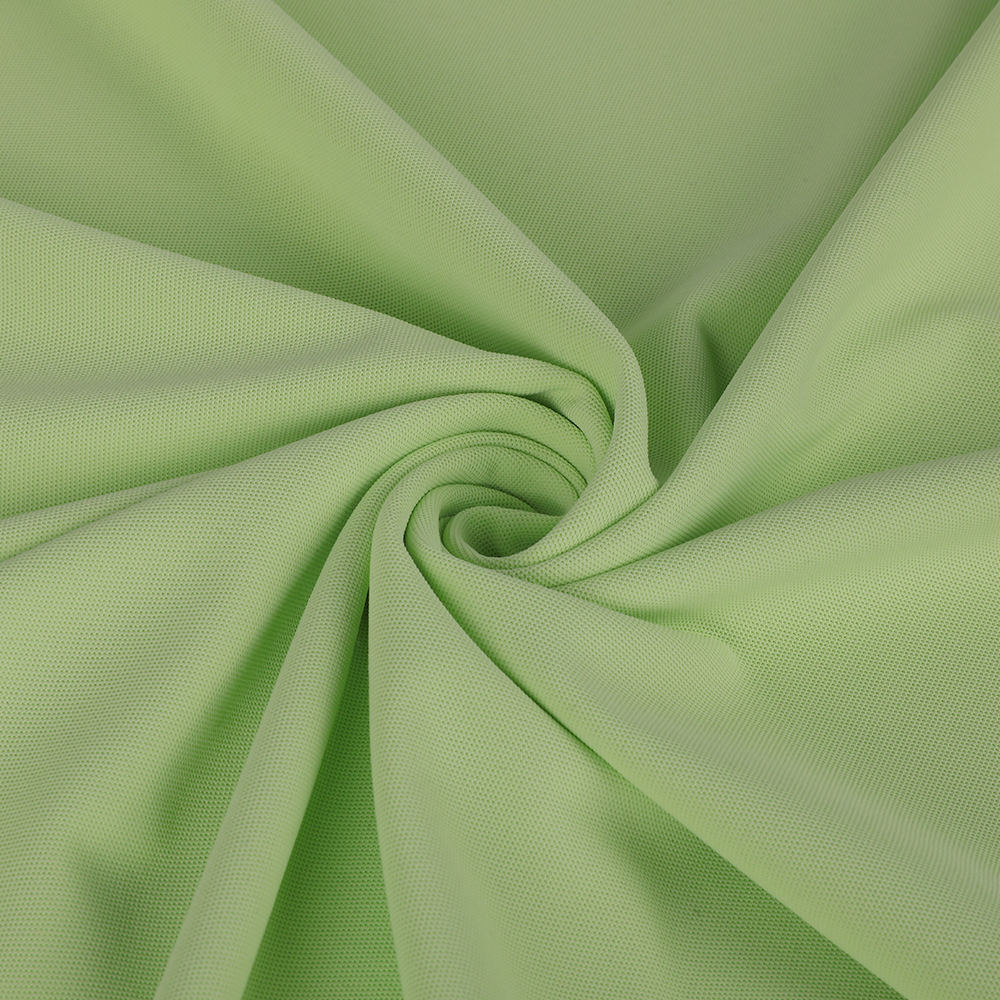
- Piqué / Swiss piqué stitch: A textured knit construction producing a characteristic raised grid or honeycomb surface pattern. The standard construction for polo shirt body fabric; provides superior breathability versus plain single jersey due to the open textured surface. Swiss piqué produces a finer, more consistent piqué cell structure favored in premium polo shirt fabric.
- Punto di Roma (six-course): A double-knit construction alternating knit and tuck stitches; produces a flat, stable, slightly textured surface with excellent recovery and body. Used in structured shirt and blouse fabrics where dimensional stability and shape retention are prioritized.
Woven Cotton Shirt Fabrics
Woven constructions are standard for formal and smart-casual dress shirts, where structured appearance, dimensional stability, and the ability to hold a pressed crease are required. Key woven constructions in cotton shirt fabric wholesale include:
- Plain weave (poplin): The most common woven shirt fabric; balanced plain weave with equal warp and weft density; smooth, tight surface; weight 90–130 g/m². Excellent printability; the standard base fabric for cotton dress shirts.
- Oxford weave: A basket-weave variation with two warp yarns interlacing with one weft yarn; produces a textured, heavier fabric (140–180 g/m²) with a characteristic grainy surface. Standard for Oxford button-down shirts in the smart-casual category.
- Twill weave: Diagonal rib surface structure; produces a softer, more drapeable fabric than plain weave at equivalent weight; used in chino shirts, work shirts, and premium cotton blend dress shirts.
- Satin / sateen weave: Long float structure produces a smooth, lustrous surface with excellent drape; used in premium formal shirts and luxury shirt fabric programs.
Fabric Weight Guide for Shirt Applications
| Fabric Weight (g/m²) | Construction | Typical Application | Season |
|---|---|---|---|
| 100–140 | Single jersey / plain poplin | Lightweight T-shirt, summer casual shirt | Spring / Summer |
| 150–180 | Single jersey / Oxford weave | Standard T-shirt, casual shirt, polo shirt | All season |
| 180–220 | Interlock / piqué / twill | Premium polo, structured casual shirt | All season / transitional |
| 220–280 | Heavy interlock / double knit | Premium sweatshirt, heavy polo, work shirt | Autumn / Winter |
| 280–350+ | Fleece / terry / high-pile | Sweatshirt, hoodie, cold-weather casual | Winter |
3. Cotton Blends in Shirt Fabric: Performance Enhancement
Pure cotton shirt fabric delivers outstanding comfort, breathability, and natural hand, but it has recognized limitations in wrinkle resistance, dimensional stability after washing, and moisture management. Cotton shirt fabric wholesale programs increasingly incorporate strategic fiber blends that preserve the natural comfort of cotton while addressing these performance gaps.
Common Blend Combinations and Their Benefits
| Blend Composition | Primary Benefit | Typical Application |
|---|---|---|
| Cotton / Polyester (60/40 – 80/20) | Wrinkle resistance; reduced shrinkage; improved durability | Workwear shirts, uniform shirts, casual shirts |
| Cotton / Elastane (95/5 – 97/3) | Stretch and recovery; improved fit retention | Fitted T-shirts, stretch polo, slim-fit shirts |
| Cotton / Linen (60/40 – 70/30) | Enhanced breathability; textured natural aesthetic | Summer casual shirts, resort wear |
| Cotton / Modal (50/50 – 70/30) | Improved drape; enhanced softness; moisture wicking | Premium T-shirts, luxury casual shirts |
| Cotton / Silk (70/30 – 80/20) | Luxury luster; superior softness; premium positioning | Luxury dress shirts, fashion shirts |
| Cotton / Wool or Cashmere (80/20) | Warmth; refined hand; premium aesthetic | Autumn/winter casual shirts; knitwear-style shirts |
4. Quality Standards for Cotton Shirt Fabric Wholesale
Quality assurance in cotton shirt fabric wholesale procurement requires specification and verification of a defined set of performance parameters before committing to bulk production orders. The following parameters represent the minimum quality gate criteria for professional B2B fabric procurement.
Key Physical Performance Parameters
| Parameter | Standard / Target | Test Method |
|---|---|---|
| Fabric weight (GSM) | Specified ±5% | ISO 3801 |
| Dimensional stability (wash shrinkage) | ≤ 5% warp; ≤ 5% weft (AATCC 135) | AATCC 135 / ISO 6330 |
| Pilling resistance | Grade ≥ 3.5 (residential); ≥ 4 (commercial) | ISO 12945-2 (Martindale) |
| Wash color fastness | Grade ≥ 4 staining; ≥ 4 fading | ISO 105-C06 |
| Rubbing fastness (dry/wet) | Grade ≥ 4 dry; ≥ 3 wet | ISO 105-X12 |
| Light fastness | Grade ≥ 4 (standard); ≥ 5 (outdoor) | ISO 105-B02 |
| Bursting strength (knits) | ≥ 200 kPa | ISO 13938-1 |
| Seam strength | ≥ 200 N (ISO 13935-2 grab method) | ISO 13935-2 |
| pH value | 4.0 – 7.5 (skin contact) | ISO 3071 |
| Formaldehyde content | ≤ 75 mg/kg (adult garments) | ISO 14184-1 |
Chemical Safety Compliance
Cotton shirt fabric wholesale buyers sourcing for EU, US, or other regulated markets must verify chemical compliance across the following key frameworks:
- OEKO-TEX Standard 100: Tests for more than 100 harmful substances including restricted azo dyes, heavy metals, formaldehyde, pesticide residues, and pH. The most widely recognized consumer-facing certification for safe textiles; required by most European and North American retail brands.
- REACH Regulation (EC) No 1907/2006: SVHC (Substances of Very High Concern) compliance declaration required for all textile products sold in the EU.
- GOTS (Global Organic Textile Standard): Required for certified organic cotton shirt fabric; covers both fiber origin (certified organic cotton) and chemical processing standards throughout the supply chain.
- Bluesign / ZDHC MRSL: Manufacturing restricted substances list compliance; increasingly required by global sports and outdoor brands for their wholesale cotton fabric for shirts supply chains.
5. Wholesale Sourcing Guide: What to Evaluate in a Supplier
Production Technology and Equipment
The machinery platform of a cotton shirt fabric wholesale supplier directly determines its capability to deliver the knit structures, yarn count range, fabric quality consistency, and production scale that wholesale buyers require. Key equipment criteria to evaluate include:
- Machine gauge range: Fine gauge (28–36 gauge) machines are required for producing lightweight, fine-count cotton knit shirt fabric in single jersey, interlock, and piqué constructions. Coarser gauge (12–18 gauge) machines produce heavier constructions for sweatshirts and knitwear-style shirts.
- Jacquard capability: Electronic jacquard control enables pattern knitting without changeover; critical for producing branded, fashion, or multi-color knit shirt fabric.
- Machine origin: Circular knitting machines from Italian (Santoni, Lonati), German (Mayer & Cie), Swiss (Jakob Müller), Japanese (Fukuhara, Precision Fukuhara), or Taiwanese (Pai Lung) manufacturers are the global benchmarks for precision, stitch consistency, and reliability in premium fabric production.
- Finishing equipment: Compacting, calendering, sanforizing, and brushing machines are required to achieve dimensional stability, controlled shrinkage, and the surface hand specified in premium cotton shirt fabric programs.
Design and R&D Capability
For buyers seeking differentiated cotton shirt fabric wholesale products rather than commodity constructions, the supplier's design and R&D team capability is a critical evaluation criterion. Key indicators of strong design capability include:
- Proportion of technical and design staff in total workforce (20%+ is a quality indicator)
- In-house CAD/CAM knit programming capability for custom stitch development
- Active new product development pipeline with seasonal fabric collections
- Ability to develop custom blends, yarn counts, and stitch specifications to buyer brief
- Sample development lead time of 10–15 working days for standard constructions; 20–30 days for custom developments
Minimum Order Quantities and Supply Flexibility
MOQ (minimum order quantity) structures vary significantly across the cotton shirt fabric wholesale supplier landscape:
- Large-scale commodity suppliers: MOQ 2,000–5,000 kg per color per construction; optimized for high-volume, low-variety procurement programs.
- Mid-scale specialty knitters: MOQ 300–1,000 kg per color; suitable for fashion brands, mid-size garment manufacturers, and private label programs with multi-SKU requirements.
- Premium specialty mills: MOQ 100–500 kg for standard constructions; custom development orders may carry higher MOQs due to machine setup costs.
6. About Jiaxing Jinkaiyue Knitted Fabric Co., Ltd.
Company Overview
Founded in 2000, Jiaxing Jinkaiyue Knitted Fabric Co., Ltd. is a dedicated manufacturer of high-end knitting fabrics headquartered in Jiaxing, Zhejiang Province — one of China's most advanced textile manufacturing regions. With over two decades of focused production experience in premium knitted fabrics, Jinkaiyue has established a strong reputation among domestic and international buyers seeking quality, technical depth, and reliable supply in cotton shirt fabric wholesale and specialty knit fabric categories. The company employs approximately 300 staff members, with a notably high proportion of 20% engaged in research, technology, and design — reflecting a genuine commitment to product innovation and technical excellence rather than pure commodity volume production.
Fiber and Material Expertise
Jinkaiyue's material expertise spans the full premium fiber spectrum, encompassing mulberry silk, long-staple cotton, linen, wool, cashmere, and various high-performance fiber blends. This breadth of fiber knowledge, combined with in-house blending and yarn specification capability, enables Jinkaiyue to develop premium cotton shirt fabric constructions — including cotton-silk, cotton-linen, cotton-cashmere, and cotton-modal blends — that are not available from commodity knit fabric suppliers. For wholesale buyers seeking differentiated fabric propositions for premium shirt programs, this multi-fiber capability is a significant commercial advantage.
Knitting Technology and Stitch Range
Jinkaiyue operates advanced circular knitting machines from Italy, Germany, Switzerland, Japan, and Taiwan — the global benchmark origins for high-precision knitting equipment. This machinery platform enables the company to produce a comprehensive range of stitch constructions for both single jersey and double knitting, covering all the principal structures relevant to cotton knit shirt fabric production:
- Plain stitch (single jersey) and rib stitch for standard T-shirt and casual shirt fabric
- Jacquard stitch for pattern and branded knit shirt fabrics
- High-pile stitch for premium textured surfaces
- Single-blister stitch and loop transfer stitch for three-dimensional textured designs
- Pelerine stitch and eyelet stitch for openwork and breathable summer shirt fabrics
- Swiss piqué stitch — the premium construction for fine polo shirt body fabric
- Six-course Punto di Roma for structured, stable double-knit shirt and blouse fabrics
This stitch range positions Jinkaiyue as a technically capable partner for brands seeking both standard commodity constructions and specialty, high-design knit shirt fabrics from a single reliable supply source.
7. Frequently Asked Questions (FAQ)
Q1: What is the best cotton fabric for shirts?
The best cotton shirt fabric depends on the shirt style and end-use requirement. For premium casual T-shirts, ring-spun combed cotton single jersey at 160–180 g/m² delivers the optimal balance of softness, durability, and print quality. For polo shirts, Swiss piqué interlock in combed long-staple cotton (180–220 g/m²) is the benchmark construction for breathability and shape retention. For formal dress shirts, 100% combed cotton or Egyptian cotton poplin in Ne 80–100 count delivers the smooth, crisp surface and premium hand associated with quality tailoring.
Q2: What GSM is standard for wholesale cotton shirt fabric?
The standard GSM range for wholesale cotton fabric for shirts varies by shirt type. Standard T-shirt fabric runs 150–180 g/m²; premium T-shirts are typically 180–200 g/m². Polo shirts use 180–220 g/m² piqué. Lightweight summer shirts (woven) run 90–120 g/m². Heavy casual shirts and sweatshirts start from 240 g/m² and above. GSM should always be verified by ISO 3801 test on received goods, as fabric weight is a primary determinant of garment quality perception and production cutting yield.
Q3: What is the difference between combed and carded cotton shirt fabric?
Combed cotton shirt fabric uses yarn that has been processed through a combing stage after carding, which removes short fiber noils and further parallelizes the remaining long fibers. The result is a smoother, stronger yarn with significantly better pilling resistance and a cleaner, more lustrous fabric surface. Carded cotton fabric is produced without the combing stage; it is softer but hairier, with lower pilling resistance and a less refined surface appearance. For premium cotton shirt fabric programs, combed ring-spun cotton is the standard specification; carded cotton is acceptable only for budget-tier casual shirt and workwear applications.
Q4: What certifications should I request from a cotton shirt fabric wholesale supplier?
For buyers sourcing cotton shirt fabric wholesale for EU and North American markets, the minimum certification requirements are: OEKO-TEX Standard 100 (harmful substance freedom); REACH SVHC compliance declaration; and ISO 9001 quality management system certification. For organic cotton programs, GOTS (Global Organic Textile Standard) certification covering both fiber origin and processing is required. For brands with sustainability commitments, GRS (Global Recycled Standard) for any recycled fiber content and bluesign or ZDHC MRSL compliance for chemical management are increasingly standard procurement requirements.
Q5: How do I evaluate sample quality when sourcing cotton shirt fabric wholesale?
When evaluating fabric samples for a cotton shirt fabric wholesale program, assess the following in sequence: first, verify GSM against specification (weigh a 10 cm × 10 cm swatch and calculate); check dimensional stability by washing the sample at the specified care temperature and measuring shrinkage in both directions; assess pilling resistance after 500 Martindale cycles using the ISO 12945-2 method; check color fastness by rubbing the sample against white cotton (ISO 105-X12) and evaluating staining. Finally, assess hand, drape, and surface uniformity under both direct and oblique light. Request a full technical data sheet and third-party test report from an accredited laboratory (SGS, Bureau Veritas, Intertek) for any fabric being considered for bulk production commitment.
References
- Morton, W.E. & Hearle, J.W.S. (2008). Physical Properties of Textile Fibres, 4th Edition. Woodhead Publishing, Cambridge. ISBN 978-1-84569-220-9.
- Spencer, D.J. (2001). Knitting Technology, 3rd Edition. Woodhead Publishing, Cambridge. ISBN 978-1-85573-333-6.
- ISO 3801:1977 — Textiles: Woven Fabrics: Determination of Mass per Unit Length and Mass per Unit Area. ISO, Geneva.
- ISO 12945-2:2000 — Textiles: Determination of Fabric Propensity to Surface Fuzzing and to Pilling — Part 2: Modified Martindale Method. ISO, Geneva.
- ISO 105-C06:2010 — Textiles: Tests for Colour Fastness to Domestic and Commercial Laundering. ISO, Geneva.
- AATCC Test Method 135-2018 — Dimensional Changes of Fabrics after Home Laundering. American Association of Textile Chemists and Colorists, Research Triangle Park, NC.
- OEKO-TEX Standard 100, Edition 2024. OEKO-TEX Association, Zurich. Available at: https://www.oeko-tex.com/en/our-standards/oeko-tex-standard-100
- Global Organic Textile Standard (GOTS), Version 7.0. GOTS, 2023. Available at: https://global-standard.org
- REACH Regulation (EC) No 1907/2006. European Chemicals Agency (ECHA), Helsinki. Available at: https://echa.europa.eu/regulations/reach
- Kadolph, S.J. (2010). Textiles, 11th Edition. Pearson Education, Upper Saddle River, NJ. ISBN 978-0-13-511101-2.