
 English
 日本語
 中文简体

Content
A bulk wool interlock order can pass a hand-feel review and still fail at the cutting table. The cause is usually dimensional change: a 3% width shrink on a 160 cm roll removes 4.8 cm of usable width before a panel is cut.
A 3% width shrink on a 160 cm roll removes 4.8 cm of usable width before a panel is cut.
The fix is to define wool knit fabric by finished weight, fiber diameter, structure and wash performance, then verify those values on the bulk lot rather than the sample.
What Wool Knit Fabric Is on a Spec Sheet
Wool knit fabric is a loop-structured textile made from wool or wool-blended yarns, and its commercial behavior is set by fiber diameter, yarn count, loop length, machine gauge and finishing, not by the word wool alone.
Wool knit fabric is any knitted construction in which wool is the named fiber. It may be single jersey, rib, interlock, ponte or jacquard, and the wool may be blended with polyester, nylon, silk, cashmere, cotton or elastane.
Two yarn routes feed the same structure. Worsted-spun yarns use longer, parallel fibers and give a cleaner, stronger surface. Woolen-spun yarns keep shorter fibers crossed and deliver loft. A 2/48 Nm worsted yarn and a 2/28 Nm woolen yarn can both become a 240 gsm interlock, but their shrinkage, pilling and drape will not match.
Fiber diameter sets the skin-comfort ceiling. Commercial merino for next-to-skin knits commonly sits at 17.5-19.5 microns. The 19.6-22.5 micron band suits soft knitwear, while 22.6-25 microns is better for structured outerwear; above 25 microns belongs in durable blends or lined garments unless the yarn is carefully finished.
For a 100% wool interlock, Jiaxing Jinkaiyue Knitted Fabric Co., Ltd. lists an ecofriendly interlock shrinkproof wool fabric as a starting point for programs where width control matters.
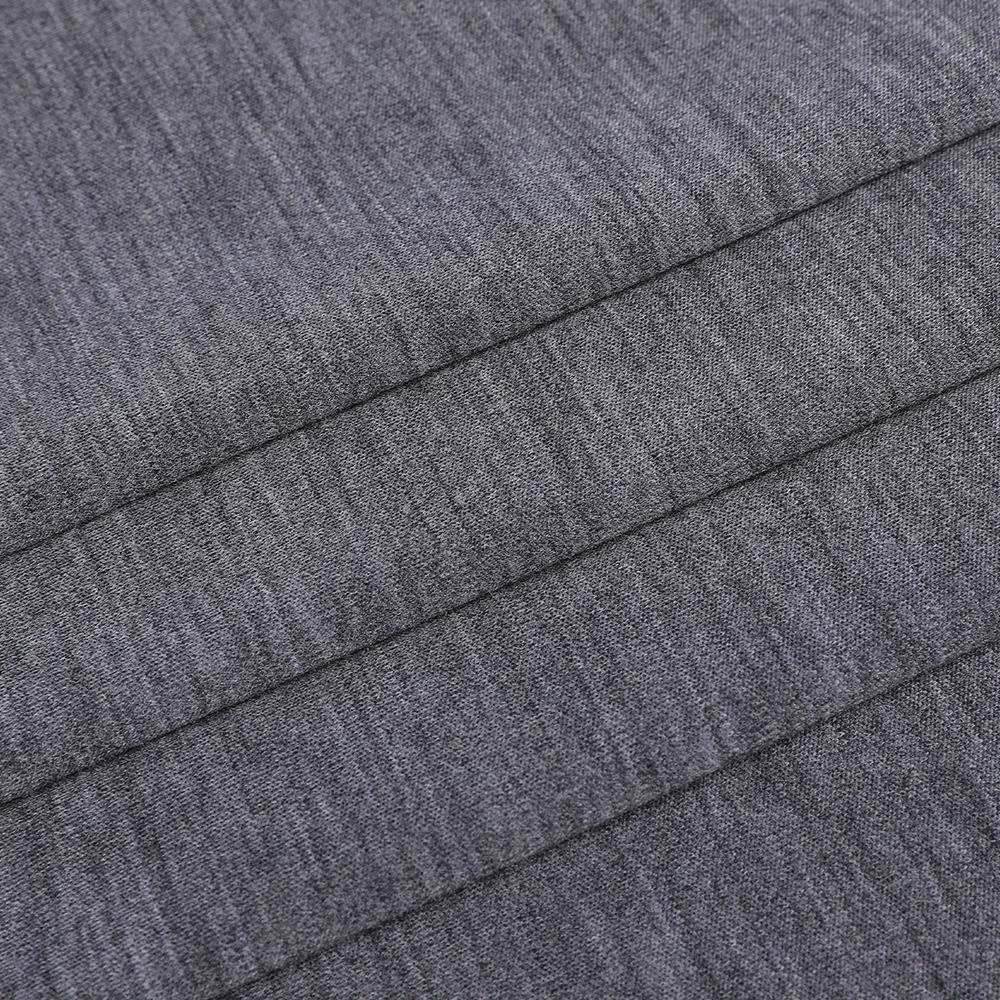 Eco-friendly Interlock Shrink-proof Wool FabricDouble-sided 99.999% shrink-proof wool at 161 cm and 165 GSM, suited to programs where width control and wash stability matter.View Product →
The Five Numbers That Predict Bulk Behavior
Bulk performance in wool knit fabric is predicted by finished weight, dimensional change, pilling grade, recovery and fiber content; hand feel alone hides all five.
| Structure | Finished weight | Behavior to control | Typical use |
| Interlock | 220-320 gsm | Width relaxation, needle line | Knit tops, dresses |
| Single jersey | 160-240 gsm | Width relaxation, light curl | Base layers, lightweight tops |
| 1x1 rib | 220-340 gsm | High recovery, narrows after wash | Cuffs, trims, bodywear |
| Ponte | 280-380 gsm | Density, seam bulk, shape retention | Trousers, jackets |
| Double jacquard | 240-360 gsm | Pattern distortion, slower cutting | Statement knits |
Name the test method in the contract. Dimensional change should be reported after ISO 6330 domestic washing and ISO 5077 measurement, with the wash program, drying method and number of cycles stated. Pilling should follow ISO 12945-2 at an agreed rub count. Fiber content should be confirmed by ISO 1833 quantitative analysis when a blend claim carries commercial value.
One caution: a width check taken straight from the roll is not a bulk prediction. Wool knit fabric continues to relax after knitting, so ask for measurements after 24 hours of conditioning and after the specified wash cycle.
A shrinkage number without a wash method is not a specification.
Choose the Blend by Failure Mode
Choose a wool blend by naming the failure mode first: pilling, shrinkage, abrasion, recovery or cost.
Wool-rich route
- Highest warmth per gram and a clear natural hand.
- Strong premium story, but price follows raw wool.
- Risk: shrinkage without shrink-resist finishing and pilling in low-twist woolen yarns.
Blend-led route
- 20-30% nylon improves strength and abrasion.
- 30-50% polyester controls cost and drying time.
- 5-8% elastane adds recovery; higher levels can cause growth in heavy knits.
Jiaxing Jinkaiyue Knitted Fabric Co., Ltd. organizes its wool knit offer across wool knitted, wool/nylon, wool/polyester, wool/spandex, silk/wool, cashmere, cotton/modal/wool and silk/cashmere qualities; the full knitted wool fabric range shows how those routes are grouped.
Wool/polyester is the volume route for many cut-and-sew programs because it reduces cost and speeds drying while keeping a wool surface. The comfortable soft interlock shrinkproof wool fabric in that group is a useful benchmark.
 Comfortable Soft Interlock Shrink-proof Wool FabricWool/polyester interlock at 60/40, 178 cm and 239SM, offering wash stability and a soft hand for cut-and-sew programs weighing cost and drying.View Product →
Cashmere is not a durability upgrade. At 5-10% it changes hand feel; at 30% or more it changes both cost and care. The wool and cashmere blend analysis sets out the ratios and trade-offs.
Bulk Sourcing Checks That Catch Failures Early
A wool knit order is only as reliable as the bulk test protocol behind it; six checks catch failures before the first cut.
- Test the finished bulk lot. A greige roll or a sample card cannot predict shrinkage after finishing and washing.
- Fix the wash method. Use ISO 6330 and ISO 5077, then set a contract limit: plus or minus 3% for cut-and-sew knitwear, or plus or minus 5% for relaxed woolen jersey where the pattern allows.
- Set pilling by end use. ISO 12945-2 grade 4 at the agreed rub count is a practical target for visible fine-gauge tops; brushed outerwear may accept grade 3-4.
- Verify fiber content by ISO 1833. A 5% cashmere claim is a laboratory item, not a label item.
- Measure usable width after 24 hours of relaxation. A 3% width shortfall on a 1,000 kg program needs about 30 kg more fabric for the same cut, before marker loss.
- Match colorfastness to the care route. ISO 105-C06 wash testing and ISO 105-B02 light testing should be set by shade, not by one house number.
The bulk lot is the only specimen that matters.
Care Claims, Cost, and the Numbers Behind Both
Machine-washable wool is an engineered finish, not a fiber property; the care claim has to be proven on the finished knit after shrink-resist processing, yarn selection and blend design.
A machine-wash claim on 100% wool interlock depends on shrink-resist treatment, yarn twist and cover factor. A hand-wash label is not a failure of the fiber; it is a missing finishing decision. Ask for wash test data on the exact bulk quality and color, because dyeing and mechanical finish change relaxation.
Cost per garment equals fabric price divided by yield, plus cutting loss and shrinkage allowance. Fix the denominator before comparing suppliers.
Price per kilogram becomes comparable only after yield is fixed. A fabric with 3% less usable width needs 3% more meters for the same marker. Wool/polyester blends also dry faster than 100% wool, which matters for travel and activewear.
For a warmer structured double jacquard, the warmth retention cotton/modal/wool double jacquard is a relevant reference where surface interest and a soft hand are required.
 Warmth Retention Double Jacquard Wool FabricPolyester/cotton/Modal/wool double jacquard at 192 cm and 167 GSM, combining warmth, softness and stable patterning for intimate apparel and casual clothing.View Product →
Practical Answers for Wool Knit Fabric Buyers
Most wool knit fabric briefs reduce to four decisions; use the figures below as starting points and confirm them on the finished bulk lot.
What wool knit is best for next-to-skin wear?
Start with 17.5-19.5 micron merino in a 160-220 gsm jersey or interlock. Specify ISO 12945-2 pilling grade 4 at the agreed rub count; below 17.5 microns, softness rises but yarn cost and fiber damage risk rise too.
What shrinkage limit should a contract specify?
Test to ISO 6330 and ISO 5077, then set plus or minus 3% in length and width for cut-and-sew knitwear. On a 68 cm body panel, 3% is 2.04 cm, enough to change the grade.
Which blend resists pilling best?
For visible fine-gauge knits, 80/20 wool/nylon or 70/30 wool/polyester in a longer-staple, higher-twist yarn is a stronger candidate than low-twist 100% woolen-spun wool. Confirm with ISO 12945-2 at grade 4.
How should prices be compared?
Compare cost per finished garment: finished weight, usable width after relaxation, shrinkage allowance and cutting loss. A 3% width loss on 1,000 kg requires 30 kg more fabric for the same cut.
Fiber diameter, finished gsm, knit structure, ISO 6330/5077 shrinkage, ISO 12945-2 pilling grade, usable width and shade-specific colorfastness.